

An effective Provider Education Program (PEP) can improve clinical documentation, increase coding accuracy, and enhance overall revenue integrity. Health systems that implement well-structured education initiatives often see reduced coding-related denials, improved compliance, and even higher provider satisfaction.
Why is Provider Education Important?
At the core of every strong revenue cycle is accurate documentation. When providers are equipped with the right tools and resources, the result is better documentation that accurately reflects the patient encounter. This leads to proper code assignment, fewer queries, and faster claim processing.
But without structured and ongoing education, even the best-intentioned providers can fall short of operational standards. E/M level confusion, under-documented chronic conditions, and specialty-specific coding errors can lead to missed reimbursement opportunities, increased audit risks, and administrative burden across departments.
Health systems that invest in provider education programs stand to gain:
- Improved documentation and coding accuracy
- Reduced coding denials and administrative burden
- Long-term operational efficiency
- Increased revenue
Despite its value, provider education often faces hurdles: low provider buy-in, limited provider time, inconsistent training quality, and trouble sustaining engagement. That’s why a tailored, data-informed approach is key to success.

Designing a Provider Education Program (PEP)
Building a provider education program starts with smart planning and stakeholder collaboration.
Assess Needs Through Audit Insights
An audit will allow your team to take an operation snapshot and make informed decisions on where to dedicate resources.
- New Provider Audits
- Yearly Compliance Provider Audits
- Coder Audits (internal coder or vendor coder)
- Department Audits
- Focused Audits (HCC, Telehealth, ED Facility infusion)
- Audits based on yearly OIG workplan
- CDI Audits
What training has been done? Where are the documentation gaps? Which specialties are at highest risk? Look for patterns in coding trends, denials, and provider behavior. For example:
- Are HCCs being under-documented?
- Are E/M levels frequently undercoded or overcoded?
- Are certain providers receiving frequent coder queries?
These insights will help you pinpoint knowledge gaps and tailor your training content accordingly.
Stakeholder Engagement
A successful provider education program requires buy-in from across the health system:
- C-Suite leadership to allocate resources and support participation
- Physician champions to advocate for the program within their departments
- Coding teams and compliance officers to provide real-world audit examples and content input
Curriculum Development
One-size-fits-all education rarely works. Instead, tailor your provider education curriculum by:
- General vs. Specialty-Specific Needs: Separate foundational training (like E/M guidelines) from specialty-specific topics (e.g., cardiology coding, psychiatric evaluations).
- Prioritize High-Risk Areas: Focus on pain points like HCC capture, chronic condition documentation, high-volume services, or payer-specific nuances.
- Include Updates: Incorporate recent regulatory changes, payer policy shifts, and CMS guidance.
Structure for Engagement and Accountability
A flexible, consistent structure helps maintain momentum and generate long-term success:
- Monthly or quarterly live workshops
- On-demand videos for efficient learning
- Quick-reference tip sheets and coding guides
- Pre/post assessments to gauge knowledge retention
- Provider feedback loops to continuously improve content
- Monitor coding denial trends to measure impact
CodingAID’s Coding Guides
CodingAID’s Coding Guides offer concise, specialty-specific guidance to help providers document accurately and efficiently. Designed to reduce errors and improve coding confidence, these quick-reference tools are a must-have for any successful provider education program.
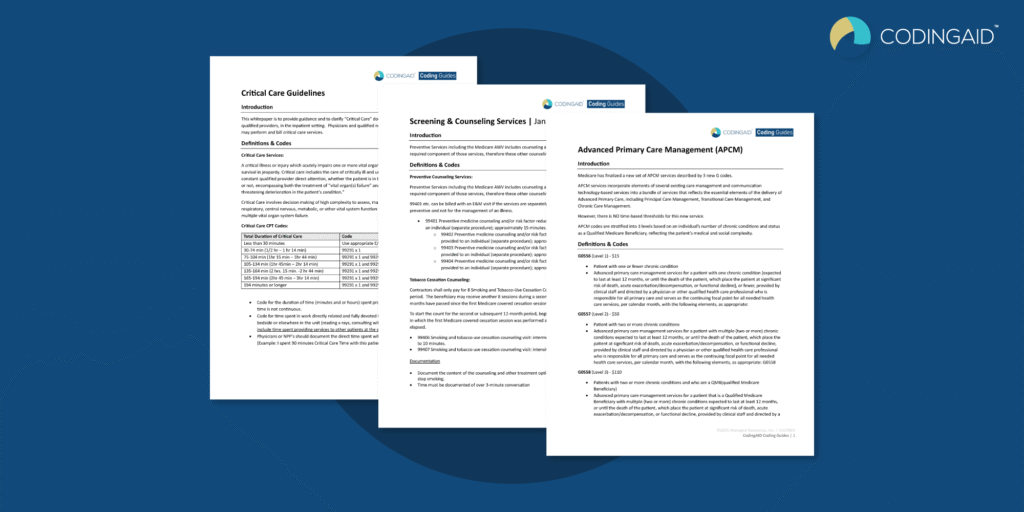
CodingAID’s Coding Guides include:
- APCM (Advanced Primary Care Management)
- AWV
- Behavioral Health Services
- Cardiovascular Risk Assessment
- Chronic Care Management (CCM)
- Concurrent Care/Copy & Paste
- Counseling Services
- Critical Care
- E & M Guidelines
- Fracture Care
- G2211: Visit Complexity
- Modifier 25
- Modifiers (Summary of all)
- Pelvic Exam (99459)
- Screening Services
- Split/Shared Services
- Teaching Physician Guidelines
- Telehealth
- Transitional Care Management (TCM)
- Visit Complexity for Infectious Disease
To learn more about CodingAID’s Coding Guides, please schedule a free consultation here.
Performing Provider Education: Delivery Models and Best Practices
Once the program is designed, the next step is implementation. Choosing the right delivery model and teaching strategies ensures the education resonates with providers.
Delivery Models
- General Education Sessions: Good for broad topics like documentation standards or new coding guidelines.
- Department-Specific Workshops: Tailored sessions for specific service lines
- Specialty-Specific Trainings: Deep dives for specialties with complex coding ( Orthopedics, Cardiology, etc.).
- 1:1 Coaching: Personalized education for providers who need focused guidance based on audit findings or performance trends.
Best Practices
- Keep sessions short and focused – respect provider time and offer flexible options, such as lunch-and-learns or virtual recordings
- Make content practical and relevant, using real examples from audits and actual notes (de-identified, of course).
- Use visual aids like documentation templates, smart phrases, and EMR screenshots to illustrate key points.
Follow-Up and Long-Term Support
Education shouldn’t end when the session does:
- Provide easy access to resources, such as tip sheets and contact info for coders.
- Maintain open communication lines for questions and clarifications.
- Track key metrics—denial rates, coding accuracy, provider engagement—to measure long-term success and identify ongoing needs.
Conclusion
Provider education is more than a compliance tool – it’s a catalyst for documentation excellence and revenue cycle transformation. With the right strategy, structure, and delivery models, health systems can equip their providers to document more accurately, reduce denials, and achieve sustainable financial performance. Whether launching a new initiative or refining your current program, investing in provider education delivers measurable results across coding, compliance, and care.
To learn more about designing a Provider Education Program (PEP) or Coding Audit services, contact us here.
If you’d like to speak with a CodingAID representative today, book a meeting here.